Tea Boiler Buying Guide: Making the Right Choice for Your Business
· 11 min read
Capacity, energy type, material, heating power, safety, water quality, installation and maintenance: everything you need to know to choose the right tea boiler for your business, with a checklist.
A tea boiler is a piece of equipment that will run for hours every day in your business. The wrong capacity, the wrong energy type or a model that does not fit your infrastructure can mean tea running out at peak time, wasted energy or early breakdowns. This guide walks you through the buying decision step by step, with links to more detailed articles under each heading.
What is a tea boiler and how is it different from a kettle?
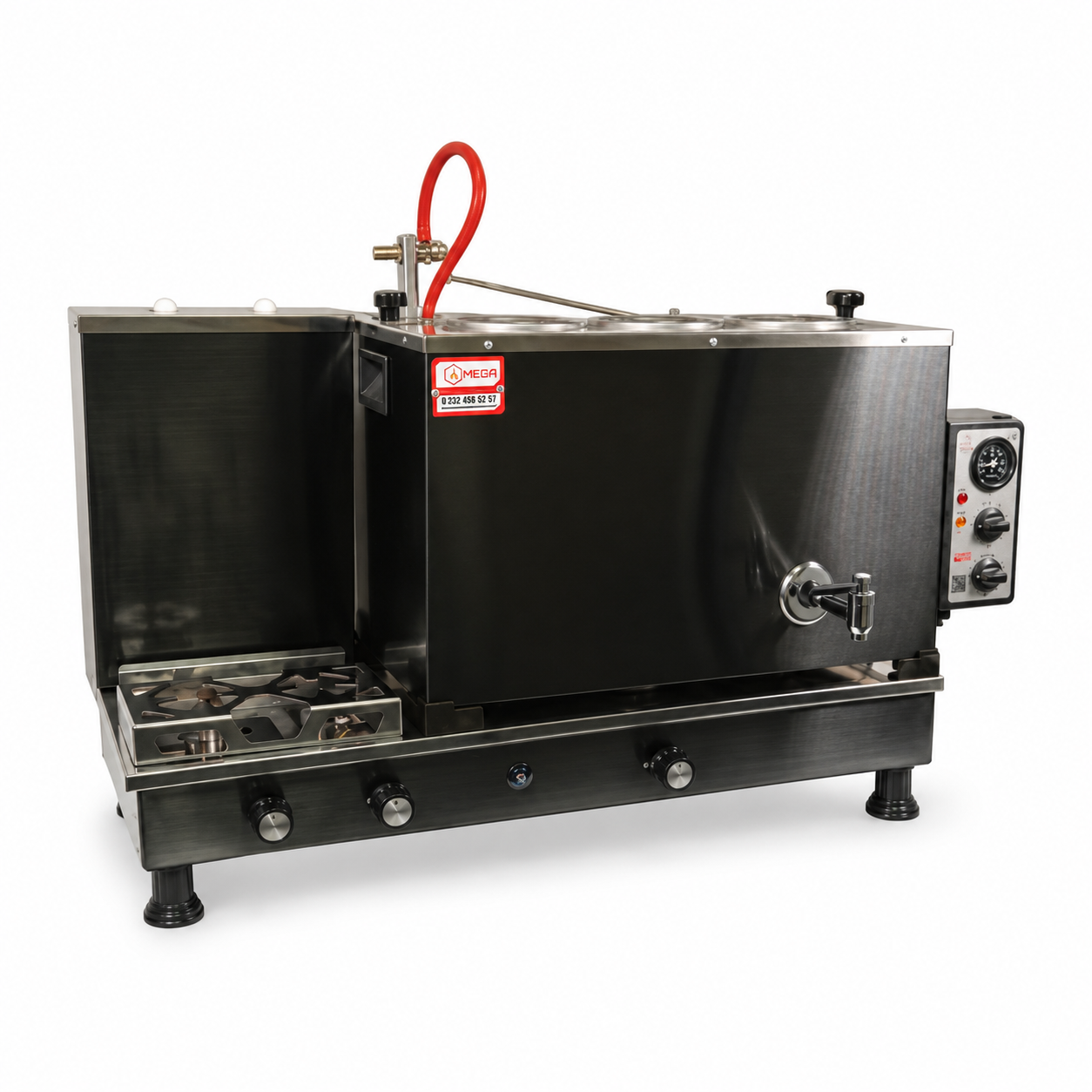
A tea boiler (Turkish: çay kazanı) is a professional appliance made up of a tank that keeps water hot, one or more teapot seats on top of that tank, and a hot-water tap. Its key difference from a household kettle is that it is designed for continuous service: a thermostat holds the water at a set temperature, models connected to the water mains refill automatically through a float system, and the teapots stay warm on top of the boiler.
Tea boilers are used wherever tea is served all day: cafés, traditional tea houses, restaurants, hotels, offices, school canteens and factory dining halls. You can browse all models in the tea boilers category.
Tea boiler, tea machine and samovar: what does each do?
These appliances are often confused. It helps to be clear about the differences before deciding:
- Teapot-style tea boiler: Scales the classic Turkish two-pot brewing method up to professional use, with a hot-water tank and teapots on top. The person serving controls brewing strength and freshness.
- Tea machine / tea dispenser: Automates part of the brewing and serving process. It aims to give a consistent result where staff change often or service is self-service.
- Samovar: Usually a single-pot, smaller and often portable appliance intended for homes, small offices or events rather than heavy all-day service.
This guide focuses on teapot-style tea boilers, the type most often chosen by businesses that serve tea all day.
Six questions to answer before you buy
- How many glasses of tea do I serve per day, and how many in the busiest hour?
- How many teapots do I need at the same time (fresh brew, waiting brew, lighter tea, etc.)?
- Which energy source do I have: a suitable electrical supply, natural gas or LPG?
- Will the boiler be visible to customers or kept in the kitchen?
- Can I connect it to the water mains and add filtration?
- Who will I contact for maintenance and spare parts?
The answers to these questions determine almost every decision in the sections below.
1. Capacity: number of teapots and litres
Two separate ideas should not be confused: the number of teapots and the tank volume (litres). The number of teapots tells you how many pots can be kept warm at once. The tank volume tells you how much hot water the boiler holds at any moment.
Peak hour matters more than daily total
Imagine two businesses that each sell 300 glasses a day. In one, consumption is spread across the day; in the other, it is concentrated in the hour after lunch. The second business needs more teapots and stronger heating despite the same daily total. That is why capacity is best planned around the number of glasses served in the busiest hour.
For mains-connected models, tank size is not the only limit
In float-controlled, mains-connected boilers, water is topped up automatically. The real limit is how fast the boiler can heat the incoming cold water, in other words its heating power. For manually filled models, tank volume directly determines how often you need to refill.
General orientation table
This table is not a strict rule but a starting point. For a precise choice, follow the steps in our capacity calculation guide (Turkish).
| Number of teapots | Typical use case |
|---|---|
| 1–2 teapots | Office tea point, small café, low to medium demand |
| 3 teapots | Medium-sized cafés and restaurants with steady service |
| 4 teapots | Busy restaurants, tea houses, hotel breakfast areas |
| 5–6 teapots | Tea houses, factory and school dining halls, shift-based heavy service |
2. Energy type: electric, natural gas or LPG
The choice of energy type usually depends on the infrastructure you already have. Each option has strengths and weaknesses:
| Criterion | Electric | Gas (natural gas / LPG) |
|---|---|---|
| Installation | A suitable circuit and connection; the supply must be checked against the rated power | Gas piping and connection must be done by an authorised installer |
| Temperature control | Precise and automatic via thermostat | Depends on the model; thermostatic burner models exist |
| Ventilation | No combustion, so no flue or combustion ventilation needed | Adequate ventilation for combustion products is essential |
| Running cost | Depends on the electricity unit price | Depends on the gas unit price and burner efficiency |
| Best suited to | Offices, shopping centres, premises without gas | High-demand businesses with gas already installed |
Which option is cheaper to run depends on current local tariffs. We explain the calculation method step by step in our electric vs gas comparison (Turkish). Models that run on both gas and electricity are listed in the turbo tea boilers category (Turkish).
3. Material: copper, chrome and stainless steel
Material affects both appearance and how you maintain the boiler. Many boilers sold as "chrome" (krom or kromat) in Turkey are actually made of chromium-nickel stainless steel, so always check the steel grade stated on the product page.
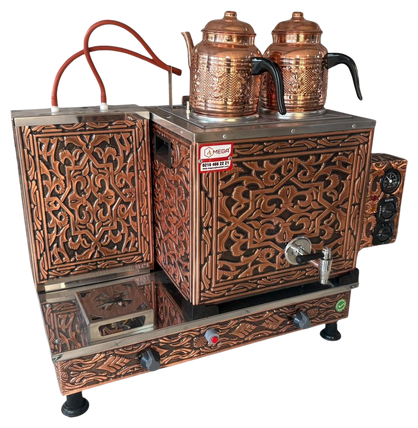
- Copper body: A traditional, decorative look, often chosen for counters that customers can see. It needs regular care to keep its shine. In many models only the outer body is copper while the inner tank that touches water is stainless steel; ask about the inner tank material before buying.
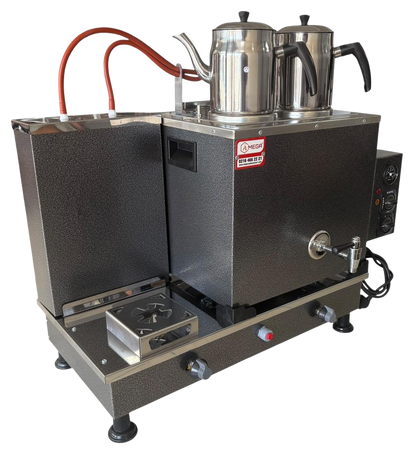
- Chrome / stainless steel: Easy to clean, corrosion-resistant and practical for hygiene inspections. A common choice for kitchens and heavy use.
- Powder-coated body: Offers colour options; resistance of the coating to impact and heat varies by manufacturer.
For a detailed comparison see our copper vs chrome guide (Turkish); you can compare the current body options in the tea boilers category (Turkish).
4. Heating power and heat-up time
The power of an electric boiler is stated in kW (kilowatts). Higher power heats water faster, but your electrical supply must also be able to carry that load. Physics gives a simple way to estimate heat-up time: raising 1 litre of water from about 15 °C to 100 °C theoretically requires about 0.1 kWh of energy.
Example (theoretical): A 30-litre tank needs roughly 30 × 0.1 = 3 kWh. A 3 kW heating element would heat that water in about one hour, ignoring losses. In practice, heat losses make it take somewhat longer. This also answers the question "how long before opening should I switch the boiler on?"
For all heat-up and consumption calculations, see our article on tea boiler electricity consumption (Turkish).
5. Controls and safety features
Check the product page or data sheet for the following:
- Thermostat: Holds water at a set temperature, reducing unnecessary boiling and wasted energy.
- Float (water level control): Keeps the water level constant in mains-connected models and helps prevent overflow and dry running.
- Dry-run / overheat protection: Safety devices that stop the heating element burning out when there is no water.
- Flame safety on gas models: Ask whether there is a device that cuts the gas supply if the flame goes out.
- Earthing and correct cable size: Electric models must always be connected to an earthed circuit.
6. Water quality and filtration
Hard (calcareous) water leaves a layer of limescale on the heating element and tank. Limescale makes it harder for heat to pass into the water, which can lengthen heat-up time and strain the element. If your water is hard, planning a suitable filter at the inlet and descaling regularly is important for the life of the appliance. Practical steps are in our cleaning and descaling guide (Turkish).
7. Installation and infrastructure checklist
- For electric models, have an electrician confirm that the circuit and breaker suit the boiler's rated power. High-power models may require a three-phase connection.
- For gas models, connection, leak testing and ventilation assessment must be carried out by an authorised gas installer.
- Mains-connected models need a water valve nearby; if a filter will be used, plan its position in advance.
- Check the size, load capacity and heat resistance of the counter where the boiler will stand.
- Tap height should leave enough room for the glasses and teapots you use.
Safety note: Electrical and gas connections, and any repairs to these systems, must be carried out by qualified, authorised technicians.
8. Maintenance, service and spare parts
The parts replaced most often in tea boilers are the heating element, thermostat, float and tap. Before buying, find out whether these parts are easy to source and whether the model/label information is clear. Getting the right part quickly keeps the boiler from being out of service for long. For spare parts, contact us with your boiler's model information.
9. Budget: purchase price and running cost
The price tag is only part of the total cost. When comparing, consider together:
- Purchase and installation cost (circuit, piping, filter)
- Daily energy consumption (electricity or gas)
- Periodic maintenance and descaler costs
- Spare part prices and availability
- The risk of downtime if something breaks
A boiler much larger than you need can cost more both to buy and to run, because extra water is kept hot all day. One that is too small will slow service at peak time.
10. Quick recommendations by type of business
Café
The boiler often stands on a counter customers can see, so appearance and compact size matter. Service is spread through the day but peaks in the afternoon and evening. Two- or three-pot models are usually considered; if there is no gas supply, electric models are a practical choice.
Traditional tea house
Demand is high and continuous all day, and tea must be refreshed quickly. Multi-pot, high-power, mains-connected (float-controlled) models stand out. Heavy use makes descaling and access to spare parts even more important.
Restaurant
Service peaks sharply after meals. Whether the boiler sits in the kitchen or at the bar affects the choice of material: easy-clean stainless surfaces in the kitchen, more decorative models in the dining area.
Hotel and breakfast room
There is a short, intense peak at breakfast and low demand later. Allow for pre-heating time before breakfast and choose the number of teapots according to the peak.
Office
Demand is low to medium and many different people use the appliance. Easy-to-use, thermostatic one- or two-pot electric models with clear safety features and simple cleaning are usually sufficient.
Factory and dining hall
Large volumes are served in a very short time between shifts. Tank volume (pre-heated water ready to use) and number of teapots must be considered together, and more than one boiler may be needed. For purchases at this scale, requesting a quote and assessing infrastructure in advance is the safest route.
Common buying mistakes
- Deciding on price alone: A low price tag can mean thin sheet metal, hard-to-find parts or insufficient heating power.
- Ignoring the peak hour: A boiler chosen on daily totals can fall short at the busiest time.
- Checking infrastructure too late: Discovering after delivery that the circuit is inadequate or the gas installation unsuitable costs time and money.
- Not asking about the inner tank: Especially with decorative models, always find out which surface touches the water.
- Overlooking water hardness: Using hard water without a filter or maintenance shortens part life.
Warranty, documents and after-sales
Before buying, check the warranty period and scope, whether a warranty certificate is provided, whether the user manual is available in your language, and whether power, voltage and model information are clearly shown on the product label. Model and label details are also what you will need to find the correct spare part later. Asking in advance how the seller supports installation and first start-up helps you avoid surprises on opening day.
First steps after delivery
- When unpacking, check the body for dents or transport damage.
- Confirm that the power, voltage and gas type on the label match the model you ordered.
- Read the user manual and share it with your staff.
- Have connections made by an authorised technician.
- Before first use, fill and heat the tank, then discard that water; wash the teapots.
- Check the thermostat setting and that the float shuts off water at the correct level.
Quick buying checklist
- I have calculated the number of glasses in my peak hour.
- I have decided on the number of teapots and tank volume.
- I chose the energy type to match my infrastructure, and my supply has been checked.
- I know the body and inner tank materials.
- I checked the thermostat, float and safety features.
- I assessed water hardness and the need for a filter.
- I asked about spare parts and service access.
- I compared total cost of ownership (purchase + running).
Next step
If you are not sure which model suits you, answer a few questions in our tea boiler selection wizard to get a recommendation. For multiple units, custom sizes or corporate purchases, you can request a quote.
Frequently Asked Questions
What is the most important factor when buying a tea boiler?
There is no single factor, but capacity is the starting point. Work out how many glasses you serve in your busiest hour; the number of teapots, tank volume and heating power follow from that. Then choose the energy type that fits your infrastructure and the material that suits where the boiler will stand.
Is an electric or a gas tea boiler cheaper to run?
It depends on current local electricity and gas tariffs and on the appliance efficiency. Calculating the same heat demand for both energy types using the unit prices on your own bills gives the most reliable comparison.
Does the water touch copper in a copper tea boiler?
It depends on the model. In many copper boilers only the outer body is copper and the inner tank that touches water is stainless steel. Check the inner tank material in the product information or ask the seller in writing before buying.
Can I install a tea boiler myself?
Checking the electrical circuit, three-phase connections, gas piping and leak testing must be done by qualified, authorised technicians. You can handle physical preparation such as placing the boiler on the counter.
Which spare parts are replaced most often?
The heating element, thermostat, float and tap are the parts replaced most often. Because limescale shortens the life of the element and thermostat, regular cleaning helps reduce the need for replacements.